Custom Labels: Materials, Adhesives, Formats & Uses
A custom label is an adhesive graphic where information is the primary purpose, typically used to identify, describe, instruct, organize or track a product, package or asset.
Labels can combine branding with functional information such as product names, ingredients, barcodes, warnings or variable data. Their performance depends on the complete construction, including face material, adhesive, print method, finish, application surface and environment.
What Is a Custom Label?
A custom label is an adhesive graphic where information is the primary purpose. Labels are designed to identify, describe, instruct, organize or track a product, package or asset.
Unlike stickers, where the design itself is typically the primary purpose, labels support the item they are applied to by communicating useful information. This can include product names, ingredients, instructions, warnings, barcodes, batch information or variable data.
A label can also carry branding and decorative elements, but its defining role is the information it communicates.
Label Format, Material, Adhesive & Finish
Label terms often describe different characteristics of the product rather than different types of labels. Understanding the distinction makes it easier to compare options and choose the right label construction.
| Category | What It Describes | Common Examples |
|---|---|---|
| Format | How labels are supplied for application | Rolls, sheets, individual labels |
| Face Material | The printable material that forms the label | PP, PET, PVC, paper |
| Adhesive | How the label bonds to the application surface | Permanent, removable (low-tack), hi-tack |
| Surface Treatment | Whether and how the printed surface is coated or protected |
Uncoated, varnish, laminate |
| Finish | How the final surface looks or feels | Gloss, matte, satin |
For example, a label supplied on a roll is not defined by a specific material or adhesive. The same roll format can use different face materials, adhesives, surface treatments and finishes depending on the product, application method and intended use.
Specialty effects such as holographic, glitter, metallic or shimmer are not a separate construction layer. They can originate from the face material, ink, laminate or a combination of these.
Expert Note
Label performance comes from the complete construction. Format, face material, adhesive, surface treatment and finish describe different characteristics of a label and should not be treated as interchangeable product categories.
How a Custom Label Is Constructed
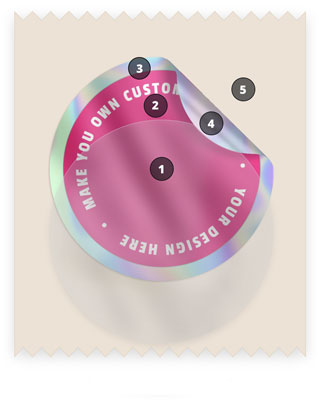
A self-adhesive custom label can consist of up to five functional layers. Each layer influences print quality, appearance, adhesion, durability and how the label performs in its intended application.
-
1. Protective Top Layer / Surface Treatment (Optional)
The printed surface may be left uncoated, protected with a varnish, or covered with a separate laminate. The appropriate treatment depends on the required resistance to abrasion, moisture, chemicals and handling, as well as the desired finish. -
2. Ink & Print Layer
This layer carries the printed information and graphics, which may include branding, product information, instructions, barcodes, warnings and variable data. Print method and ink system affect color reproduction, durability and compatibility with the face material. -
3. Face Material
The face material is the printable substrate that forms the main body of the label. Common materials include paper, PP, PET and PVC, each offering different properties such as flexibility, tear resistance, moisture resistance and dimensional stability. -
4. Adhesive
The pressure-sensitive adhesive bonds the label to the application surface. Adhesive selection depends on factors such as surface material, texture, temperature, moisture, expected lifespan and whether the label needs to be removable. -
5. Release Liner (Backing)
The release liner protects the adhesive before application and allows the label to be removed cleanly from its backing. Labels supplied on rolls or sheets remain attached to the liner until they are applied by hand or dispensing equipment.
Expert Note
A label should be specified as a complete construction, not by face material alone. A suitable material paired with the wrong adhesive, surface treatment or application conditions can still result in poor label performance.
Sticker vs Label vs Decal vs Transfer: What's the Difference?
For labels, the defining characteristic is information. They may include branding and decorative elements, but their primary role is to identify, describe, instruct, organize or track the product, package or asset they are applied to.
| Feature | Stickers | Labels | Decals | Transfers |
|---|---|---|---|---|
| Defined primarily by | Design | Information | Placement | Application method |
| Primary Purpose | Branding, giveaways & decoration | Product information & packaging | Signage, vehicle & window graphics | Apply graphics to another surface |
| Supply Format | Individually cut or on sheets | Supplied on rolls or sheets | Individually cut | Carrier sheets or transfer films |
| Common Materials | PVC, PP, PET, Paper | PP, PET, Paper | Primarily PVC and other graphic films | Transfer films, inks & adhesives |
| Typical Application | Laptops, notebook covers, giveaways | Bottles, jars, retail boxes | Storefronts, car bumpers, equipment | Transferred by pressure, heat or water |
Label Material Families Explained
The face material is the printable layer that forms the body of a label. Material choice affects appearance, flexibility, moisture resistance, tear resistance and how well the label performs on its intended product or package.
For self-adhesive labels, common material families include paper, polypropylene (PP) and polyester (PET). PVC (vinyl) is also used for more specialized applications where flexibility, conformability or outdoor durability may be required.
-
Paper
Paper is one of the most widely used label materials, particularly for dry products, packaging and indoor applications. It offers excellent printability and is available in coated, uncoated and textured constructions.
Best for: Product packaging, retail products, dry goods, shipping and identification labels.
Why choose it: Excellent print quality, broad availability and a natural paper appearance when moisture resistance or extreme durability is not required.
-
Polypropylene (PP)
PP is a lightweight synthetic film with good resistance to water, oils and tearing. It provides greater durability than paper while remaining suitable for a wide range of packaging applications.
Best for: Bottles, jars, cosmetics, food packaging, household products and general product labeling.
Why choose it: Good moisture resistance and durability with a lightweight construction, making it a versatile choice for everyday film labels.
-
Polyester (PET)
PET is a strong, dimensionally stable synthetic film that can provide excellent resistance to moisture, heat, chemicals and physical wear, depending on the construction.
Best for: Electronics, equipment, asset identification, industrial products and durable product labeling.
Why choose it: High dimensional stability and durability for applications where the label must remain readable and intact under more demanding conditions.
-
PVC (Vinyl)
PVC is a flexible and conformable synthetic film that can adapt well to curved, irregular or more demanding surfaces. It is generally more specialized in label applications than paper, PP or PET.
Best for: Curved or irregular surfaces, equipment, outdoor products and applications requiring greater conformability.
Why choose it: High flexibility and conformability where a more rigid film may not follow the application surface as effectively.
Expert Note
Material alone does not determine label performance. The face material must be matched with the adhesive, surface treatment, application surface and environmental conditions. A water-resistant film, for example, does not automatically make the complete label suitable for prolonged water exposure.
Surface Treatments & Finishes Explained
A label's surface treatment and finish describe different characteristics. Surface treatment describes whether and how the printed surface is coated or protected, while finish describes how the final surface looks or feels.
-
Uncoated
An uncoated label has no additional varnish or laminate applied over the printed surface. Its appearance and performance therefore depend largely on the face material, ink and print process.
Best for: Dry indoor applications, paper labels, packaging and applications where additional surface protection is unnecessary.
-
Varnish / Clear Coat
A varnish, sometimes called a clear coat, is a liquid coating applied over the printed surface and then dried or cured. It can add protection against handling, abrasion and moisture while adding relatively little thickness compared with a separate laminate film.
Best for: Product labels, packaging and roll labels that need moderate surface protection without a separate laminate film.
-
Laminate
A laminate is a separate transparent film applied over the printed face material. It can provide greater protection against abrasion, moisture, chemicals and environmental exposure, depending on the laminate construction.
Best for: Durable product labels, frequently handled products, moisture-prone environments and more demanding applications.
Common Label Finishes
| Finish | Appearance & Feel | Best for |
|---|---|---|
| Gloss | Smooth, reflective surface with higher light reflection |
Vibrant graphics, product packaging and applications where a polished appearance is preferred |
| Matte | Low-reflection surface with a softer appearance | Premium packaging, reduced glare and applications where readability is important |
| Satin | A balanced surface between gloss and matte | Labels that need moderate reflection with a smooth, understated appearance |
Expert Note
Specialty effects such as holographic, glitter, metallic or shimmer should not be confused with surface finish. They can originate from the face material, ink, laminate or a combination of these. For example, a holographic laminate can have either a gloss or matte finish.
Material + Surface Treatment: They Work Together
The face material provides the foundation of a label, while the surface treatment determines whether and how the printed surface is protected. These should be selected together based on the product, application and environment.
For example:
-
Paper + varnish creates an economical label with added protection against handling and light moisture.
-
PP + varnish provides a moisture-resistant film construction with additional print protection for many packaging applications.
-
PP + laminate adds a separate protective film for applications exposed to more frequent handling, moisture or abrasion.
-
PET + laminate can create a highly durable construction for equipment, industrial products and other demanding applications.
Expert Note
There is no single “best” label material. The right construction comes from matching the face material, surface treatment, adhesive, application surface and environmental conditions to the intended use.
Understanding Label Adhesives
The adhesive determines how a label bonds to its application surface. Choosing the right adhesive depends on the surface material, texture, temperature, moisture, expected lifespan and whether the label needs to be removed later.
-
Permanent Adhesive
Permanent adhesive is designed to create a strong, lasting bond to suitable surfaces. Once fully bonded, removal may damage the label, leave adhesive residue or affect the application surface.
Best for: Product packaging, bottles, jars, retail products and general-purpose labeling where the label is intended to remain in place.
Why choose it: A versatile choice for applications where reliable, long-term adhesion is more important than clean removal.
-
Removable / Low-Tack Adhesive
Removable or low-tack adhesives are designed to provide sufficient adhesion while allowing the label to be removed more easily and with less risk of residue or surface damage.
Best for: Temporary identification, promotional labels, reusable containers and applications where clean removal is important.
Why choose it: Allows labels to perform their function temporarily without creating the stronger long-term bond associated with permanent adhesives.
-
Hi-Tack Adhesive
Hi-tack adhesive provides stronger initial adhesion and is designed for surfaces that can be difficult for standard adhesives to bond to effectively.
Best for: Rough or textured surfaces, some low-surface-energy plastics, industrial containers and other difficult-to-bond substrates.
Why choose it: Provides stronger initial grab where a standard permanent adhesive may struggle to establish sufficient contact with the surface.
-
Freezer / Cold-Temperature Adhesive
Cold-temperature adhesives are formulated for applications where labels are applied or used in refrigerated or frozen environments. The correct adhesive depends on both the application temperature and the service temperature after application.
Best for: Frozen foods, refrigerated products, cold storage and packaging exposed to low temperatures.
Why choose it: Designed to maintain suitable adhesion under temperatures where a conventional adhesive may become too firm to wet out and bond effectively.
Why the Application Surface Matters
Adhesives need to make close contact with a surface to form a reliable bond. Smooth surfaces such as glass, painted metal and many coated materials are generally easier to bond to than rough, contaminated or very low-surface-energy surfaces.
This is why choosing an adhesive should always start with one question:
What surface will the label be applied to?
From there, factors such as outdoor exposure, temperature, removability and expected lifespan help determine the most appropriate adhesive.
Expert Note
A “stronger” adhesive isn't automatically a better adhesive. Bond performance depends on the surface energy, texture and cleanliness of the application surface, as well as temperature and application conditions. The best adhesive is the one formulated for the target surface, environment and intended use.
How to Apply Custom Labels for Reliable Adhesion
Even the right label material and adhesive can perform poorly if the application surface or conditions are unsuitable. Proper application helps the pressure-sensitive adhesive make close contact with the surface and develop a reliable bond.
-
Clean the Surface
Remove dust, dirt, grease, oil, wax and other contaminants before applying the label.
For many non-porous surfaces, isopropyl alcohol and a clean, lint-free cloth work well. Always make sure the cleaner is compatible with the product or packaging surface and allow it to dry completely before application.
Avoid: Applying labels over dust, oil, silicone, condensation, wax or cleaning-product residue.
-
Check the Application Temperature
Both the label and the application surface should be within the adhesive manufacturer's recommended application temperature range.
Many general-purpose pressure-sensitive adhesives require moderate application temperatures. Freezer and cold-temperature adhesives are specifically formulated for applications where labels must be applied at lower temperatures.
Application temperature should not be confused with service temperature. A label may withstand freezing temperatures after application while still requiring a warmer surface when first applied.
-
Position & Apply
For hand-applied labels, position the label carefully before allowing the adhesive to make full contact with the surface.
Peel the label from the release liner rather than pulling the liner away from the label where practical. Avoid touching the adhesive, as oils from your fingers can reduce contact in the affected area.
For labels applied using dispensing or automated equipment, roll direction, liner construction, label spacing and dispensing characteristics can also affect application performance.
-
Apply Firm, Even Pressure
Apply firm, even pressure across the entire label to help the adhesive wet out and make close contact with the application surface.
Pay particular attention to edges and labels applied to curved containers, where insufficient contact can contribute to edge lifting.
On flexible packaging or squeezable containers, the label construction should also be suitable for the movement and deformation of the package.
-
Allow the Adhesive to Build Its Bond
Pressure-sensitive adhesives often continue developing bond strength after application.
Depending on the adhesive, surface and environmental conditions, this can take several hours to several days. Where possible, avoid exposing newly labeled products to washing, condensation, refrigeration, heavy handling or other demanding conditions immediately after application.
Always follow the label or adhesive manufacturer's recommended bonding time when available.
Expert Note
Application temperature and service temperature are not the same thing. A label may perform in refrigerated or frozen conditions once fully bonded but require a different minimum temperature during application. Surface cleanliness, application pressure, temperature and bonding time can be just as important as choosing the correct face material and adhesive.
Frequently Asked Questions
What is the difference between a label and a sticker?
The main difference is their primary purpose. A label is primarily designed to communicate information about the product, package or asset it is applied to, such as a product name, ingredients, instructions, warnings, barcodes or identification data.
A sticker is primarily defined by its design and is commonly used for branding, decoration, giveaways or self-expression.
The same face material and adhesive could be used for either. What makes it a sticker or label is primarily its purpose, not the material itself.
What is the best material for custom labels?
There is no single best label material. The right choice depends on the product, application surface, environment and required lifespan.
Paper is widely used for dry packaging and indoor applications. PP offers greater moisture resistance for general product labeling. PET is commonly chosen for more demanding applications requiring dimensional stability and durability, while PVC can be useful where greater flexibility and conformability are required.
The face material should always be considered together with the adhesive and surface treatment.
Are custom labels waterproof?
Some label constructions can withstand water and moisture, but water resistance depends on the complete label construction, not just the face material.
A synthetic face material such as PP or PET may resist water, while the ink, surface treatment and adhesive must also be suitable for the intended exposure. A label intended for occasional moisture has different requirements from one exposed to prolonged water, condensation or repeated washing.
What adhesive should I choose for my labels?
Choose the adhesive according to the application surface, environment and whether the label needs to be removed.
A permanent adhesive works well for many general-purpose applications. Removable or low-tack adhesives are useful when clean removal is important. Hi-tack adhesives can help with difficult-to-bond surfaces, while freezer or cold-temperature adhesives are designed for applications involving refrigerated or frozen conditions.
A stronger adhesive is not automatically better. The adhesive should be matched to the target surface and application conditions.
Are roll labels better than sheet labels?
Neither format is inherently better. The right format depends primarily on how the labels will be used and applied.
Roll labels are well suited to larger quantities, dispensing and automated or semi-automated application. Sheet labels are convenient for smaller quantities, storage and manual application.
The supply format does not determine the label's material, adhesive or finish. The same type of label construction may be available in different formats depending on the manufacturer.